
Axe Throwing in Austin: The Anti-Screen Night Out Your Group Actually Needs
A fresh, social angle for Axe Force South Austin
Austin Has Plenty of Entertainment. What It Needs More Of Is Real Connection.
Austin is not short on things to do. Between live music, patios, food trucks, trails, breweries, movie nights, pop-ups, and weekend events, the city gives people plenty of reasons to leave the house. Visit Austin's things-to-do guide is full of the kind of variety that makes this city easy to love. But there is a quieter problem hiding underneath all that choice: a lot of nights out still end up feeling passive.
You sit. You scroll while waiting. You check the group chat. Someone takes a picture of the food. Someone else checks the score. The concert is good, the drink is good, the restaurant is good, but half the table is still drifting in and out of the same screen habit they were trying to escape.
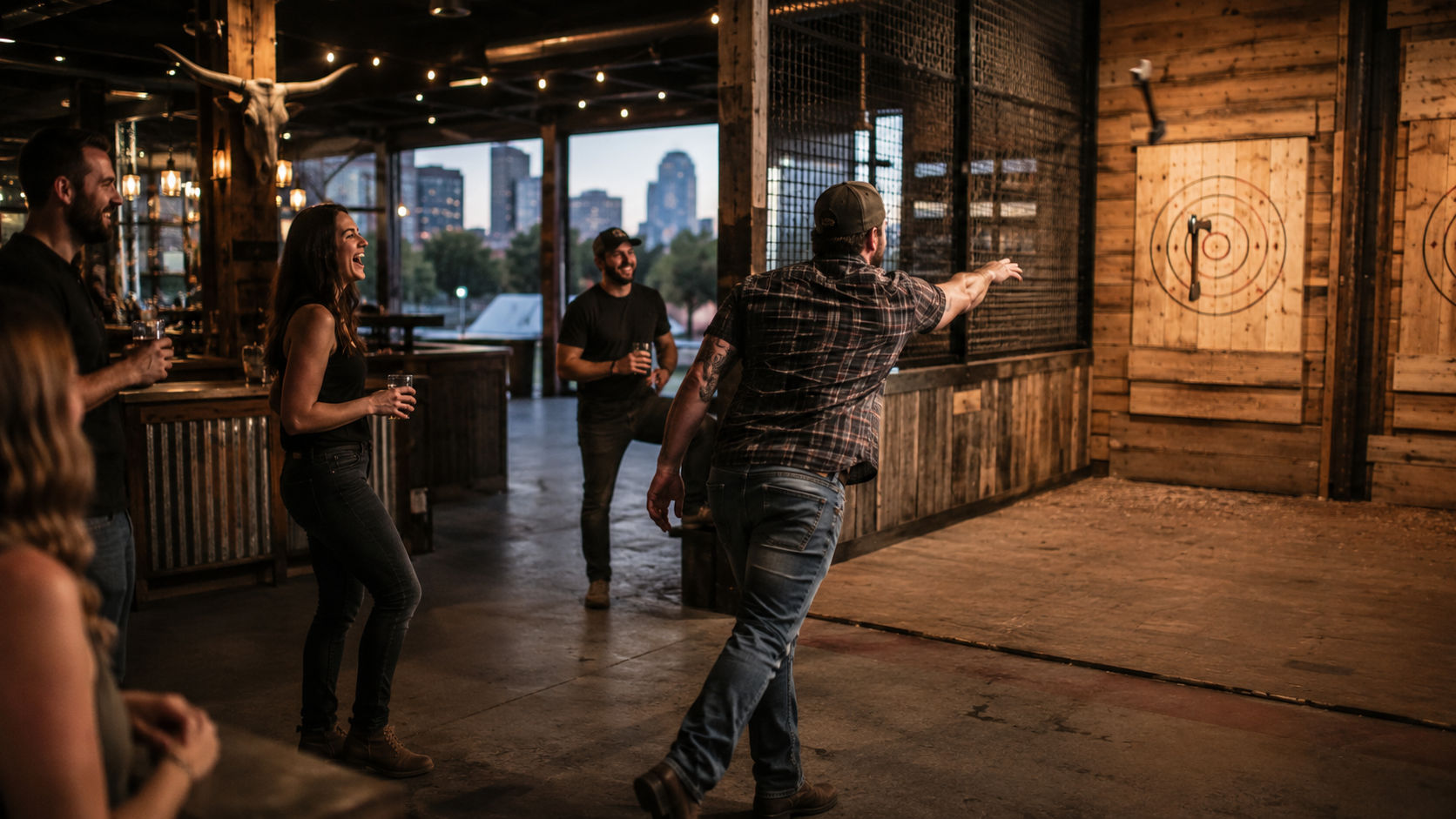
That is where axe throwing hits differently. It is not just another activity to fill a calendar slot. It gives your group a physical challenge, a reason to cheer, a reason to laugh, and a shared story that does not rely on everyone staring at a phone. For groups looking for axe throwing in Austin, the real value is not only the bullseye. It is the reset.
At Axe Force South Austin, the appeal is simple: walk in with your friends, coworkers, date, family, or out-of-town guests, learn the basics, start throwing, and let the night build around real reactions. No complicated planning. No awkward silence. No pressure to be an expert. Just a lane, a target, a throw, and the sudden realization that everyone is actually paying attention.
The Fresh Angle: Axe Throwing as an Anti-Screen Night Out
Axe throwing is often described as a birthday party idea, a team-building activity, or a fun date night. All of that is true, but it misses one of the best reasons to book a lane: axe throwing is one of the rare modern activities that naturally pulls people out of screen mode.
You cannot throw well while half-focused. You cannot casually check email mid-throw. You cannot fake participation while your friend steps up, lines up, and sends the axe toward the target. The activity itself asks everyone to be present, and it does it without feeling like a lecture about "being more present."
That matters because most people do not need another app, another subscription, or another perfectly curated outing. They need something that breaks the pattern. They need a night where the group looks up, moves around, gets a little competitive, and remembers how easy it is to have fun when the plan gives everyone something to do.
Social connection is not just a nice bonus. Harvard Health has written about the value of an active social life and the way regular connection can support mood, thinking, memory, and overall well-being. That does not mean axe throwing is medical advice. It simply means a good social activity has value beyond the hour on the calendar. When people laugh together, compete together, and encourage each other, the experience tends to stick.
Axe throwing gives that kind of connection a structure. It is active without being exhausting. Competitive without being too serious. Simple enough for beginners, but satisfying enough for people who want to improve. Most importantly, it creates moments that belong to the group, not the algorithm.
Why Passive Plans Fall Flat
Passive plans are easy to arrange, which is why they dominate. Dinner. Drinks. A movie. Another bar. Another patio. Another event where the main job is to show up and consume something. Those plans can absolutely be great, especially in a city like Austin. But they can also become repetitive.
If your friend group has hit the point where every meetup feels like a different version of the same night, the issue might not be the people. It might be the format. A table conversation can stall. A movie gives you something to watch, but not much to do together during the actual experience. A crowded bar can be loud enough to make real conversation hard. A concert is memorable, but it is usually built around the performer, not your group.
Axe throwing flips the center of attention back onto the people you came with. The entertainment is not happening on a stage across the room. It is happening right in front of you, one throw at a time. Your friend who swore they would be terrible suddenly sticks a great throw. The quiet person in the group gets unexpectedly competitive. Someone celebrates like they just won a championship after hitting the board for the first time. Those small reactions become the night.
That is the difference between watching a memory happen and making one. Axe throwing gives people a reason to react to each other in real time, which is exactly what many social plans are missing.
The First Throw Is the Icebreaker
The hardest part of many group outings is the first ten minutes. People arrive at different times. Nobody knows whether to sit, order, mingle, or wait. If the group includes new people, coworkers, in-laws, dates, or friends of friends, the early energy can feel stiff.
Axe throwing solves that quickly because the activity itself becomes the icebreaker. There is something inherently funny and disarming about stepping up to throw an axe for the first time. Even confident people usually start with a little uncertainty. Even athletic people have to learn the motion. Even beginners who feel nervous discover that everyone else is learning too.
That shared beginner status is useful. It lowers the social stakes. Instead of trying to impress each other through conversation alone, people get to connect through effort. Someone asks for a tip. Someone copies a stance. Someone celebrates a near miss. Someone jokes that their throw was "strategic intimidation." Suddenly, the group has its own language for the night.
A great social activity gives people permission to be a little silly without feeling embarrassed. Axe throwing does that naturally. It is bold enough to feel exciting, but structured enough to feel safe and approachable.
Why Axe Throwing Works for Mixed Personalities
Every group has a mix. There is the competitive person who wants a scoreboard immediately. The cautious person who needs a few throws to warm up. The joker who turns every miss into a performance. The quiet observer who slowly gets better until everyone realizes they are a threat. The planner who just wants the outing to go smoothly. The person who came along reluctantly and ends up asking for one more round.
Axe throwing works because it gives all of those personalities a role. The competitive person gets a challenge. The social person gets reactions. The cautious person gets repetition. The funny person gets material. The planner gets an activity with a clear structure. The reluctant guest gets something simple enough to try without feeling trapped in a complicated game.
That is why axe throwing can work for friend groups, couples, adult families, bachelor and bachelorette groups, work teams, and out-of-town visitors. It does not require everyone to have the same taste in music, food, nightlife, fitness, or hobbies. It only asks everyone to try.
In Austin, where people often have very different ideas of a "good night out," that flexibility is a major advantage. Some people want a competitive activity. Some want a casual hangout. Some want something indoors. Some want a story they can tell later. Axe throwing lands in the middle of all of those needs.
A Physical Activity Without the Gym Energy
One reason axe throwing feels satisfying is that it is physical, but not in a way that feels like a workout class. You do not have to be in peak shape. You do not need special athletic ability. You do not need to train beforehand. You learn a simple motion, you repeat it, and you feel the improvement as your throws get cleaner.
That physical feedback matters. When the axe sticks, you feel it. When your throw improves, you can see it. When you miss, you understand there is something to adjust. It gives your brain a simple loop: try, adjust, try again. That loop is far more engaging than sitting still and waiting for entertainment to happen around you.
It also gives people a healthy outlet for stress. After a long workweek, a rough commute, a frustrating project, or just too much time indoors staring at screens, there is something deeply satisfying about putting your focus into a controlled throw. It is not chaos. It is not rage. It is a skill-based release with rules, technique, and a clear target.
That is part of the appeal. Axe throwing feels primal without being reckless. It has a little edge to it, but the experience is built around instruction, safety, and controlled lanes. You get the thrill without needing to pretend you know what you are doing before you arrive.
Projector Targets Make the Night More Dynamic
Traditional axe throwing is already fun, but projector target systems add another layer. Instead of staring at one static bullseye all night, guests can play different target games and challenges that keep the session moving. That variety helps groups avoid the "okay, now what?" feeling that can happen with repetitive activities.
For beginners, game variety keeps the pressure lower. A person who is not great at one format might do better in another. A group can switch from serious competition to more casual game modes. People can chase accuracy, points, friendly rivalries, or just the satisfaction of landing a throw at the right moment.
For guests comparing options for indoor axe throwing in Austin, this is one reason to look closely at the actual experience, not just the category. Axe Force South Austin combines the classic satisfaction of throwing with a modern target setup, and the venue also lists straightforward axe throwing prices for guests choosing between a shorter session and a longer hangout.
A good axe throwing session should not feel like a novelty that wears off after five minutes. It should build. The first throw gets people interested. The first stuck throw gets them excited. The first close game gets them invested. By the end, people are usually talking about the throws they almost made as much as the ones they landed.
A Better Date Night for People Tired of Interview-Style Dates
For couples and first dates, axe throwing has another advantage: it breaks the interview pattern. A lot of dates accidentally become a question-and-answer session across a table. Where did you grow up? What do you do? What do you like to do for fun? Those questions are useful, but they can also make the night feel like a polite audition.
Axe throwing gives the date a shared mission. You still talk, but the conversation has something to orbit around. There is a built-in reason to laugh, tease, encourage, and celebrate. You get to see how someone reacts to learning, missing, improving, competing, and not taking themselves too seriously.
That can reveal more than another hour of small talk. Does the person laugh at themselves? Do they cheer for you? Do they get weirdly intense in a fun way? Do they relax once the activity starts? Do you feel more comfortable after doing something together instead of just sitting across from each other?
For Austin date nights, that is valuable. The city has no shortage of restaurants and bars, but a memorable date usually needs a hook. Axe throwing gives you one. It can be the main event, the before-dinner activity, or the thing you do when you want the night to feel less predictable.
A Strong Option for South Austin Groups
South Austin has its own rhythm. It is close enough to the city's main entertainment energy, but it does not always feel like a downtown night out. Visit Austin describes South Austin as a place with restaurants, shops, character, and a more local feel, which is part of why activities in this part of town can work so well for casual group plans.
For people who live south, work south, or simply do not want to fight downtown parking and crowds, an activity in South Austin can make the entire outing easier. That matters more than people admit. A plan that sounds fun but feels inconvenient is less likely to happen. A plan that is easy to understand, easy to invite people to, and easy to build the rest of the night around has a much better chance.
That is one of Axe Force's strengths. It gives South Austin groups a real activity without requiring them to turn the night into a production. You can keep it simple: book a lane, show up, throw, compete, laugh, and then decide whether the night continues somewhere nearby or ends on a high note.
The best local activities are the ones that are easy to say yes to. Axe throwing checks that box because the concept is simple, the time commitment is manageable, and the experience feels different from another ordinary dinner or drink plan.
How to Make the Most of Your Session
Axe throwing is beginner-friendly, but a little planning helps the night run smoothly. The first decision is session length. A shorter session can work well for couples, small groups, or people adding axe throwing before dinner. A longer session is better for larger groups, more game variety, and guests who want enough time to warm up, improve, and compete properly.
The second decision is group energy. If your group is casual, keep the tone relaxed and let people rotate naturally. If your group is competitive, set up a simple tournament, crown a champion, and let the bragging rights do their job. If the group includes beginners, make sure the first round is about learning rather than scoring. People have more fun when they do not feel judged on their first few throws.
The third decision is timing. Axe throwing can work as the opening activity because it creates momentum for the rest of the night. It can also work as the main event when you want a plan that does not require multiple stops. For birthdays, friend reunions, date nights, and visiting guests, it is often easiest to make axe throwing the anchor and let food or drinks happen before or after.
For clothing, keep it practical. Closed-toe shoes are the smart move for any throwing activity. Comfortable clothes are better than anything stiff or restrictive. You do not have to dress like you are going camping, but you should wear something that lets you move naturally.
Who Should Book an Anti-Screen Axe Throwing Night?
The short answer is: almost any group that wants to actually interact. But a few groups are especially well-suited for this angle.
Friend groups that keep making the same plans can use axe throwing to shake up the routine. Instead of another night of sitting around and half-watching a game on TV, the activity puts everyone into the same shared challenge. It gives the group something to talk about besides work, dating apps, bills, traffic, and whatever happened online that week.
Couples can use it as a more active date night. It is playful, a little competitive, and much less stiff than a formal dinner. If the relationship is new, it creates easy conversation. If the relationship is established, it brings novelty back into the night.
Coworkers can use it as a lower-pressure team outing. Not every work group wants a trust fall, a forced workshop, or a formal corporate dinner. Axe throwing gives people a shared experience without making the event feel like another meeting.
Families with older kids and teens can use it as a way to get everyone doing something together. The exact age rules and safety requirements should always be checked with the venue before booking, but the broader idea is strong: activities that involve movement, coaching, and friendly competition tend to beat another night where everyone disappears into separate screens.
Out-of-town guests can use it as a memorable Austin stop. Visitors often expect food, music, and sightseeing. Those are great, but a hands-on activity gives them a story. Instead of only saying they went to Austin, they can say they threw axes in South Austin and maybe even won.
The Social Magic Is in the Turns
One underrated part of axe throwing is the rhythm. Someone throws. The group reacts. Someone else steps up. Advice is given. Jokes are made. Scores change. People rotate. That turn-based rhythm is surprisingly good for conversation because nobody has to carry the entire social load at once.
In a normal hangout, silence can feel awkward. In axe throwing, silence becomes focus. A pause is not a failure; it is someone lining up a throw. After the throw, the conversation comes back naturally. That rhythm makes the night easier for people who are not nonstop talkers and more engaging for people who need activity to stay present.
The turns also make the wins feel communal. When someone lands a great throw, the group sees it happen. When someone improves, the group notices. When someone misses badly, the group laughs with them, not at them, because everyone has been there. That shared progression is what turns a simple activity into a memory.
This is the anti-screen part at its best. The activity gives everyone a reason to watch each other, not a feed. It makes the group the content.
Why This Topic Fits Austin Right Now
Austin is growing, busy, and constantly adding new entertainment options. That is exciting, but it also makes choosing a plan harder. When every weekend has too many possibilities, people often default to the same familiar routine. The best activities cut through the decision fatigue by being easy to understand and obviously different.
Axe throwing does exactly that. It is familiar enough that people understand the concept immediately, but unusual enough to feel like a real plan. It has enough edge to be exciting, but enough structure to be beginner-friendly. It works indoors, it works for groups, and it works in a city where people are always looking for something that feels more memorable than another generic night out.
It also matches Austin's personality. This is a city that likes experiences with character. People here will go to a concert in a record shop, eat from a truck parked behind a bar, paddle a lake in the middle of downtown, and build an entire night around a place that feels a little different. Axe throwing fits that spirit because it is not polished in a corporate, forgettable way. It is physical, social, a little bold, and easy to personalize around your group.
That combination is why the anti-screen angle works. Axe throwing is not just "something to do." It is a way to make a night feel alive again.
Book the Night Your Group Will Actually Remember
A good night out does not have to be complicated. It does not need twelve stops, a perfect itinerary, or a group chat that takes three weeks to finalize. Sometimes the best plan is the one that gives people a clear reason to show up and an even better reason to stay engaged once they arrive.
That is the strength of axe throwing at Axe Force South Austin. It gives your group an activity that is active, social, beginner-friendly, competitive, and different enough to feel worth leaving the house for. It replaces passive entertainment with real reactions. It gives people something to cheer for. It makes the phone feel less interesting for a while.
So the next time your group is stuck between another dinner, another bar, another movie, or another night of scrolling separately in the same room, choose the plan with a target. Book your lane at Axe Force South Austin and give your group an Austin night out that actually feels like one.
FAQ
Is axe throwing a good group activity in Austin?
Yes. Axe throwing works well for groups because it is active, easy to learn, and naturally social. Guests take turns, cheer each other on, compete in target games, and build the night around shared reactions instead of passive entertainment.
Is axe throwing good for a date night?
Axe throwing can be a strong Austin date night because it gives couples something playful and memorable to do together. It avoids the stiff interview feeling of a table-only date and creates easy conversation through friendly competition.
Do you need experience to try axe throwing?
No. Most guests are beginners. The experience is built around learning the basic motion, practicing, and improving over the session. A good venue will explain the safety rules and help first-timers get comfortable before the competition gets serious.
What should I wear for axe throwing?
Wear comfortable clothes that allow easy movement. Closed-toe shoes are the best choice for any throwing activity. You do not need athletic gear, but you should avoid outfits that restrict your arms, shoulders, or stance.
Why choose axe throwing instead of another bar or restaurant?
Bars and restaurants can be great, but axe throwing gives your group something to actively do together. It creates movement, competition, laughter, and shared memories, which makes it a strong option when you want a night out that feels different from the usual routine.