
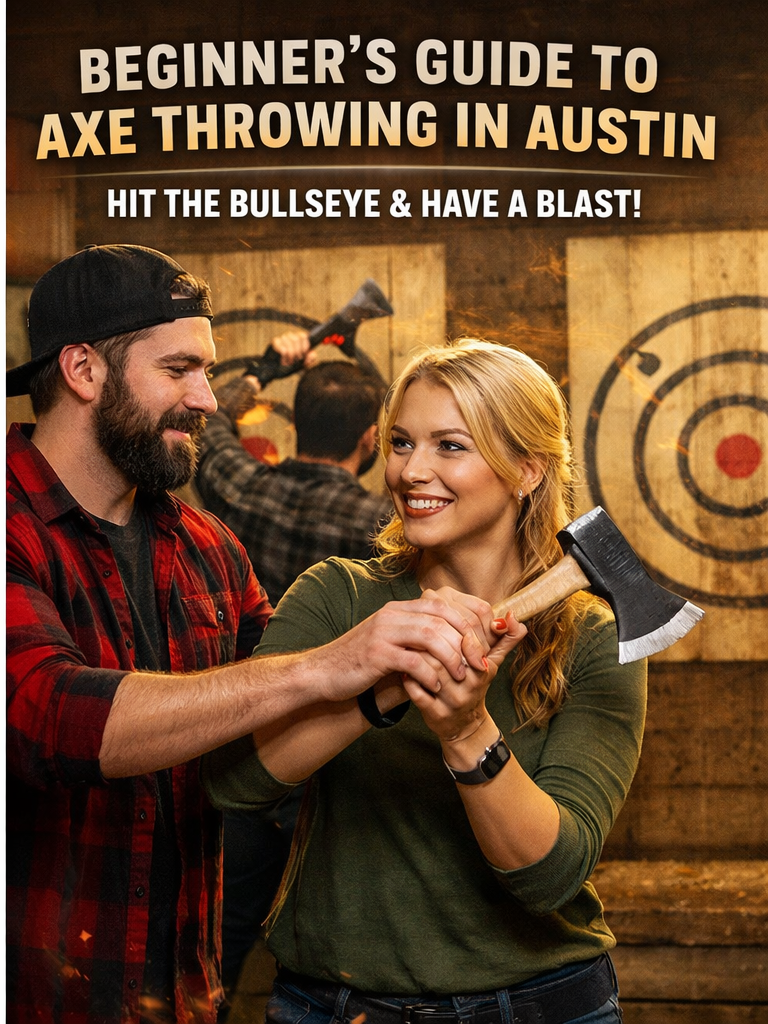
Beginner's Guide to Axe Throwing in Austin: Safety, Technique, and Games You'll Want to Play Again
Axe Force South Austin • Approx. 12 min read
What "projector target" axe throwing is (and why beginners love it)
Traditional axe throwing is already satisfying, but projector target systems add a layer that feels like a bar game crossed with a sport: the target can change, the scoring can change, and you can jump between different mini-games without moving lanes. For first-timers, that variety keeps the session fun even while you're still dialing in your throw.
If you've ever wanted an activity that's competitive, social, and surprisingly learnable in one visit, axe throwing hits the sweet spot—especially for date nights, birthdays, and small groups in Austin.
Safety first: the habits that make the sport feel effortless
Good venues run axe throwing like a "range" sport: clear lane rules, a coach briefing, and a predictable rhythm—throw, pause, retrieve. When you treat the lane with respect, axe throwing feels controlled and comfortable.
Lane etiquette that matters
- Closed-toe shoes are a must.
- Only one thrower on the lane at a time unless the coach explicitly allows side-by-side throwing for a specific game format.
- Retrieve axes only when everyone is done throwing and the lane is called safe.
- Never cross the throw line until it's your turn to retrieve.
- Handle the axe with the blade down and away from others.
If you're curious how the sport formalizes rules, the WATL publishes gameplay rules and a code of conduct that reflect the same principles most reputable venues use: consistent throwing distance, clear turn order, and sportsmanlike behavior.
The beginner throw: stance, grip, and a release that actually sticks
1) Set your stance (balance beats power)
Stand square and stable, feet about shoulder-width. Keep your weight centered and your shoulders relaxed. Many beginners try to "muscle" the throw; consistency comes from balance and a repeatable motion.
2) Pick a simple grip
A two-handed overhead throw is the most common starting point. Put your dominant hand near the bottom of the handle and your other hand above it. Keep the grip firm enough that the axe doesn't wobble, but not so tight that your wrists lock up.
3) Use a smooth swing and release at eye level
Bring the axe back in a controlled motion, then swing forward like you're tossing a ball overhead. Release when your hands come forward around eye level. Your arms should finish toward the target, not down at the floor.
How to fix the #1 beginner problem: over-rotation vs under-rotation
When an axe hits flat (handle first) or bounces, it's usually a rotation issue—not a strength issue. The fastest way to adjust is distance:
- If the blade hits high but doesn't stick (under-rotating), take a small step forward so the axe has a little more time to rotate.
- If the blade hits low or the handle slaps in (over-rotating), take a small step back.
Coaches often call this "dialing in your rotation." Once you find your distance, don't chase the bullseye by changing everything—keep the motion the same and adjust aim with tiny changes.
Aiming without overthinking: pick a spot, not a hope
Choose a specific point on the target (a knot in the wood or the center of a projected icon). Keep your eyes on that point through the swing. Beginners sometimes look at the axe during the release—don't. Your body goes where your eyes go.
Games to play on a projector target (that aren't just 'bullseye or bust')
Projector targets shine because you can rotate between games that reward different skills: accuracy, consistency, or smart risk-taking.
Classic skill-builders
- Around the World (hit zones in sequence).
- Cricket-style scoring (close out numbers with strategy).
- Timed challenges (hit as many "lit" targets as you can).
Group favorites
- Team relay (each player must hit a zone before the team advances).
- Best-of-three rounds (keeps it light and avoids long slogs).
- Upset round (lower score picks the next game—great for mixed skill levels).
What to expect on your first visit
A good first session is structured: you'll get a safety briefing, a quick demonstration, and then coached practice throws. Within a few minutes, most people get their first satisfying stick—and that's when the session clicks.
If you're bringing a group, tell everyone ahead of time: you don't need to be "strong," you just need to be consistent. The lane is more about rhythm than power.
Tips for date nights, birthdays, and group hangs in Austin
- Book a time that gives you room to grab food after (the post-game hype is real).
- Make it playful: set a silly bet (winner picks dessert).
- Take photos after the first 'big stick' moment; it's the best energy.
- If you're celebrating, ask about add-ons early so your session stays smooth.
How to get your first solid stick in 10 throws
If your goal is "I just want it to stick," focus on repeatability, not power. Here's a simple, coach-approved progression:
- Start close to the standard throwing line your venue recommends.
- Throw two-handed overhead with a relaxed grip and a straight wrist.
- Watch how the blade hits (sticks, under-rotates, or over-rotates).
- Adjust distance by a small step (6–12 inches) instead of changing your whole motion.
- Once it sticks twice in a row, stop changing distance and start aiming.
Most beginners make progress faster when they keep the swing smooth and let the axe rotate naturally. A rushed, jerky release is the enemy of consistency.
The throw mechanics that matter most
Shoulders and hips do the work; your wrists stay quiet
A common mistake is "flicking" at the end. Flicking adds unpredictable rotation. Instead, keep your wrists firm and let your shoulders guide the arc. Think: controlled pendulum, not catapult.
Step or no step?
Some people throw best from a stable, planted stance. Others prefer a small step to keep timing consistent. Either is fine as long as you do it the same way every time. If you step, keep it small and repeatable—no dramatic lunges.
Release cue: open your hands, don't throw the handle
At release, you're not "pushing" the axe toward the target. You're opening your hands so the axe continues forward. If you feel like you're pushing, your grip is probably too tight.
Troubleshooting guide: what the axe is telling you
Your target is feedback. Use it. Here are the most common outcomes and what they usually mean:
- Blade sticks but is angled sideways: you're twisting your shoulders or releasing unevenly—slow down and keep your hands centered.
- Blade hits, bounces, and drops: often under-rotation or a release that's too late—take a small step forward and keep the swing smooth.
- Handle hits first: over-rotation or a release that's too early—take a small step back and avoid wrist flick.
- Axe consistently goes left/right: your stance is drifting—reset your feet and aim with your shoulders, not your arms.
One-handed throwing (when you should try it)
One-handed throws can be fun and precise, but they're not always the best starting point. Try one-handed once you can stick consistently with two hands. The main differences:
- Your shoulder stability matters more; keep your core engaged.
- Your release timing gets touchier—tiny changes make a big difference.
- It's easier to unintentionally add spin with the wrist, so stay disciplined.
Axe throwing myths that scare first-timers (and the reality)
Myth: Axe throwing is all strength
Reality: it's timing and consistency. Plenty of people who don't consider themselves "strong" become the most accurate throwers in the room once they find their distance.
Myth: It's dangerous if people are drinking
Reality: reputable venues manage this with strict rules and coaching. Being respectful and following the lane system is non-negotiable. If someone can't follow instructions, they shouldn't throw—simple as that.
Myth: You'll never hit the bullseye if you're new
Reality: most first-timers get at least a few satisfying sticks, and many hit a bullseye on their first visit. The key is letting the coach adjust you early before you build bad habits.
Hosting a group session: how to keep it fun for mixed skill levels
Axe throwing gets better when you structure it. For birthdays and friend groups, set expectations that the first 10 minutes are practice, then you'll rotate games. For corporate groups, keep rounds short and reset often so everyone gets turns.
Formats that work well
- Short rounds (best of 3) so nobody gets stuck in a slump for long.
- Team play where a consistent thrower pairs with a beginner (built-in coaching).
- Game variety: mix accuracy games with "zone" games so different skills shine.
Want to go deeper? Friendly competitions and rule sets
Axe throwing has grown enough that formal rule sets exist, and venues often align with one or more organizations. Skimming a rule set is useful because it shows how the sport thinks about safety lines, turn order, and sportsmanship. WATL and IATF both publish codes of conduct that are easy to understand.
A simple scoring primer (so games make sense fast)
Different venues and game modes use different scoring, but most systems come back to the same idea: you earn points by hitting defined zones, and you can add special rules to create pressure and comebacks. Projector targets make this easy because the lane can swap from "accuracy mode" to "strategy mode" in seconds.
Why beginners should start with consistency games
Bullseyes are fun, but they're not the fastest way to improve. Consistency games reward repeatable mechanics—hitting the same zone three times in a row—and that's exactly what you need to build skill.
Practice drills that don't feel like practice
The three-stick drill
- Pick a single zone.
- Try to stick three axes in that same zone with the same motion.
- If you miss, don't change your whole throw—adjust distance by one small step and retry.
The 'quiet hands' drill
- Throw at half power.
- Focus on keeping wrists firm and release clean.
- Your goal is a straight, predictable rotation, not maximum force.
What to wear and what to skip
- Closed-toe shoes (non-negotiable).
- Avoid loose scarves, dangling jewelry, or anything that can swing while you throw.
- If you're wearing a jacket, pick one that doesn't restrict shoulder movement.
- Tie back long hair so it doesn't distract during the release.
Targets, wood, and why bounce-back prevention matters
Most venues use targets designed to reduce bounce-back and make sticks more consistent. End-grain wood is commonly used because it tends to accept the blade cleanly compared to harder surfaces. From a venue-operations perspective, safety guidance often highlights target materials and "no-bounce" borders as important risk controls.
FAQs first-timers actually ask
Will I embarrass myself if I'm bad at it?
No. Everyone's first few throws are calibration. The lane is literally designed for learning. The only thing you can do "wrong" is ignore the coach or treat the lane casually.
Is it okay if I'm not athletic?
Yes. The movement is simple and repeatable. Once you find your distance, you'll improve quickly.
Do I need to bring my own axe?
For casual sessions, no. Venues provide axes matched to their targets and rules. If you ever join a competition later, the venue can recommend what's appropriate for that rule set.
If you're planning an Austin outing: pair axe throwing with something nearby
Axe throwing is a great anchor activity because it's time-boxed and high-energy. Pair it with food, dessert, or a group-friendly tour to turn it into a full night out. If you're building an itinerary, Austin's meeting-planner resources are handy for brainstorming other group options.
Coach cues that instantly improve most throws
- "Relax your grip." Tight hands create late, sloppy releases.
- "Keep wrists quiet." The axe should rotate from the swing, not from a flick.
- "Finish toward the target." Follow-through keeps your line straight.
- "Same throw, small adjustments." Change distance before changing mechanics.
How to retrieve axes safely and confidently
Retrieval is part of lane discipline. Wait for the lane to be called safe, walk (don't jog), and keep awareness of other throwers. When you pull an axe from the target, pull straight out—no twisting that can surprise you or the person next to you.
If an axe sticks deep, ask your coach for the venue's preferred technique. The goal is to keep control of the tool the entire time, not to yank aggressively.
What to do when a throw goes wrong
Every first-timer eventually has a throw that goes off-line. The correct response is boring—and that's good:
- Stop and reset your feet.
- Wait for the coach if anyone is unsure about lane safety.
- Take one calm practice swing before you throw again.
The biggest safety advantage at a good venue is that the rules are simple and consistent. Follow them and you'll be fine.
If you want to improve fast after your first visit
The quickest path is one more session within a couple of weeks. Your body remembers the timing, and your second visit is where accuracy jumps. Keep your focus narrow:
- Find your distance again (it should take only a few throws).
- Commit to one throw style for the whole session.
- Play at least one consistency game before you chase bullseyes.
Casual night vs competition night: what changes
If you ever decide to join a competition, the vibe is still friendly—but rules become more standardized. You'll see consistent throwing distances, clear turn structure, and specific scoring patterns. Even if you never compete, reading a rule set once can make you a better casual thrower because you understand the lane rhythm and what "good form" looks like.
A healthy way to think about it
Casual sessions are about fun and learning. Competition sessions are about repeatability. If you bring a competition mindset (smooth, consistent, respectful) into casual play, you'll improve faster and everyone on the lane will have a better time.
Why reputable venues feel safe: supervision and clear boundaries
At a well-run venue, safety isn't a speech—it's a system. Coaches control the flow of the lane, spacing is enforced, and throwing only happens when everyone is in the right place. Organized friendly competitions emphasize the same idea: supervision, spacing, and a strict throw/retrieve rhythm keep the activity controlled.
If you're ever evaluating a venue (for a corporate event or a family outing), look for the basics: a clear briefing, staff attention on the lanes, and rules that are enforced consistently—not just posted on a wall.
External resources for rules, safety culture, and deeper technique
- WATL: Gameplay rules
- WATL: Code of conduct
- International Axe Throwing Federation: Code of conduct
- USA Archery: Archery safety (great example of range etiquette)
- Visit Austin: group activities and team-building ideas
- WATL: Mobile target compliance and supervision notes
- XINSURANCE: venue safety considerations (targets, borders, operations)
Ready to throw?
If you've been curious about axe throwing, the best way to learn is to show up once, listen to the coach, and commit to a smooth, repeatable throw. After that first solid stick, you'll understand why people get hooked so fast.
Learn more about Axe Force South Austin and book a session here: Axe Force South Austin