
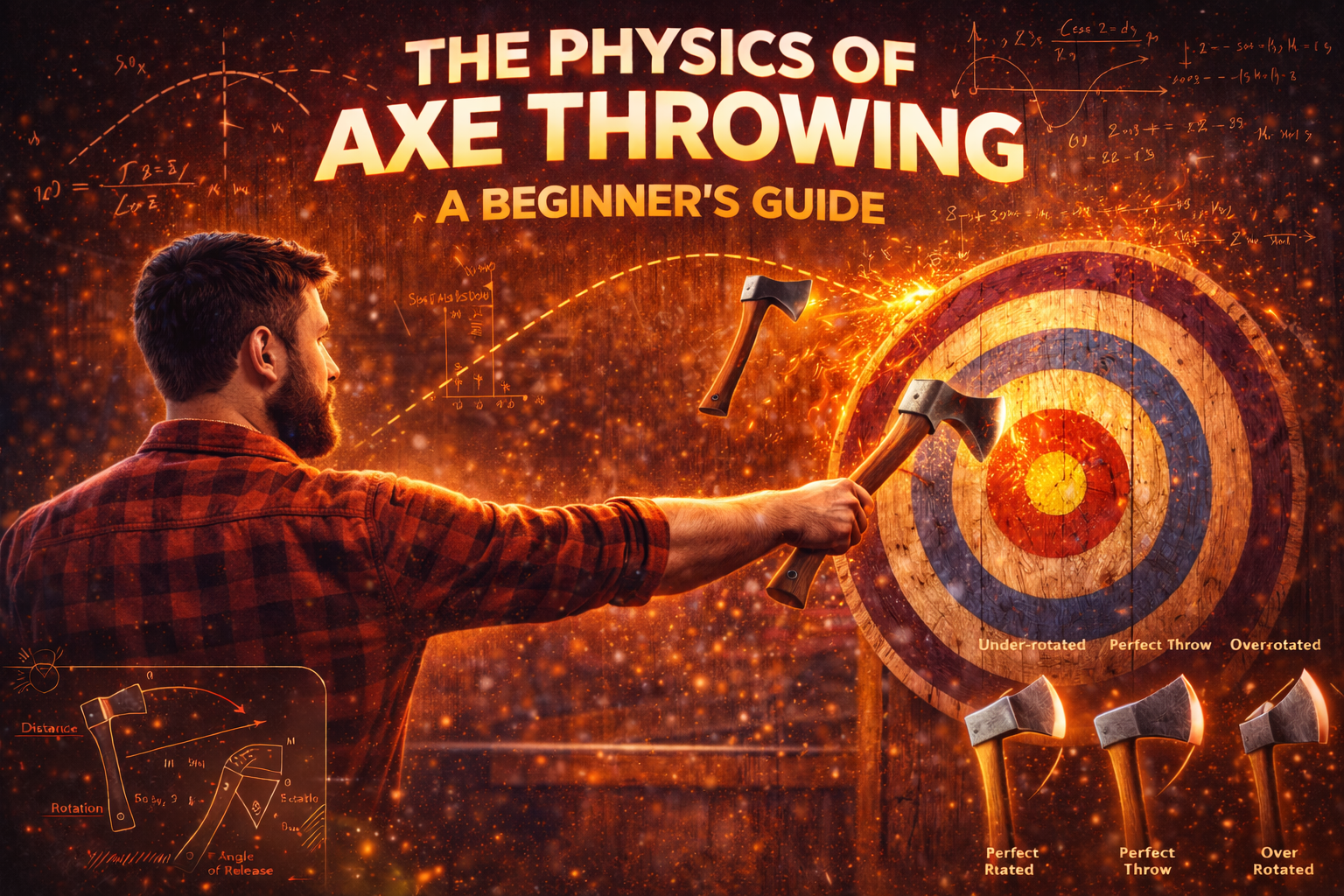
The Physics of Axe Throwing: A Beginner-Friendly Guide to Sticking More Bullseyes
Rotation, distance, grip, and the small tweaks that make projector-target axe throwing click fast at Axe Force Austin
Axe throwing looks like pure instinct—step up, swing, release, and watch the blade bite into the target. But after a few throws, most people learn the truth: sticking clean hits isn't about strength. It's about repeatable mechanics.
The good news: the physics behind a great throw is simple. When you understand rotation timing, how distance changes your number of spins, and why a relaxed release matters more than a powerful swing, your stick rate jumps fast.
This guide breaks it down in plain English so your first session at Axe Force Austin feels confident (and your group spends more time celebrating sticks than retrieving bounce-outs).
Quick takeaways
- Most misses are rotation timing—not aim.
- Handle-first impact = under-rotation; blade-first too steep = usually over-rotation.
- Distance is your best adjustment knob: small steps fix a lot.
- Relaxed grip + clean release beats power every time.
- Projector targets help you improve faster with quick drills and varied games.
Why the Axe Rotates
Every throw combines two motions:
- Forward motion (it travels to the target).
- Rotation (it spins so the blade arrives edge-first).
Your goal is simple: the axe completes the 'right amount' of rotation by the time it reaches the target.
Diagnose Your Throw in 5 Seconds
1) Handle-first (no stick)
You're under-rotating (not enough spin yet).
Fix: take a small step back (3–6 inches) OR add a slightly higher arc (not more power).
2) Blade hits but glances / steep angle
You're often over-rotating (too much rotation too soon).
Fix: take a small step forward OR release a hair earlier.
Check for wrist flick—extra wrist usually adds extra spin.
3) Sticks feel random
Your release point is inconsistent (grip tension, stride changes, or wrist movement).
Fix: simplify and throw the exact same motion three times before you adjust.
Distance Is Your Rotation Dial
Footwork fixes rotation faster than arm tweaks.
- Step back = more flight time = more rotation at impact.
- Step forward = less flight time = less rotation at impact.
Make changes in small steps. Once it sticks cleanly, keep your feet locked there for consistency.
Grip + Release (The Real Secret)
A death grip is the enemy of a clean release. Think 'secure but relaxed.'
- Keep the wrist quiet; let the swing do the work.
- Let the handle roll out of your fingers—don't 'push' it.
- Freeze your follow-through for one second with your hand pointing at the target.
3 Fast Drills to Improve Your Stick Rate
Drill 1: The 'Same Throw' Challenge
Throw three times aiming for identical mechanics. Consistency first; bullseyes second.
Drill 2: Micro-steps
If you're under/over-rotating, adjust distance by 3–6 inches and repeat until the blade arrives cleanly.
Drill 3: Follow-through freeze
After release, freeze your follow-through for one second. It reduces wrist flick and stabilizes release timing.
Want the Nerdy Version?
Ready to Stick Your First Bullseye?
Show up, get coached, and focus on two things: a repeatable throw and small distance adjustments. Most people 'click' within a few rounds.
Axe Force Austin | South Austin, Texas