
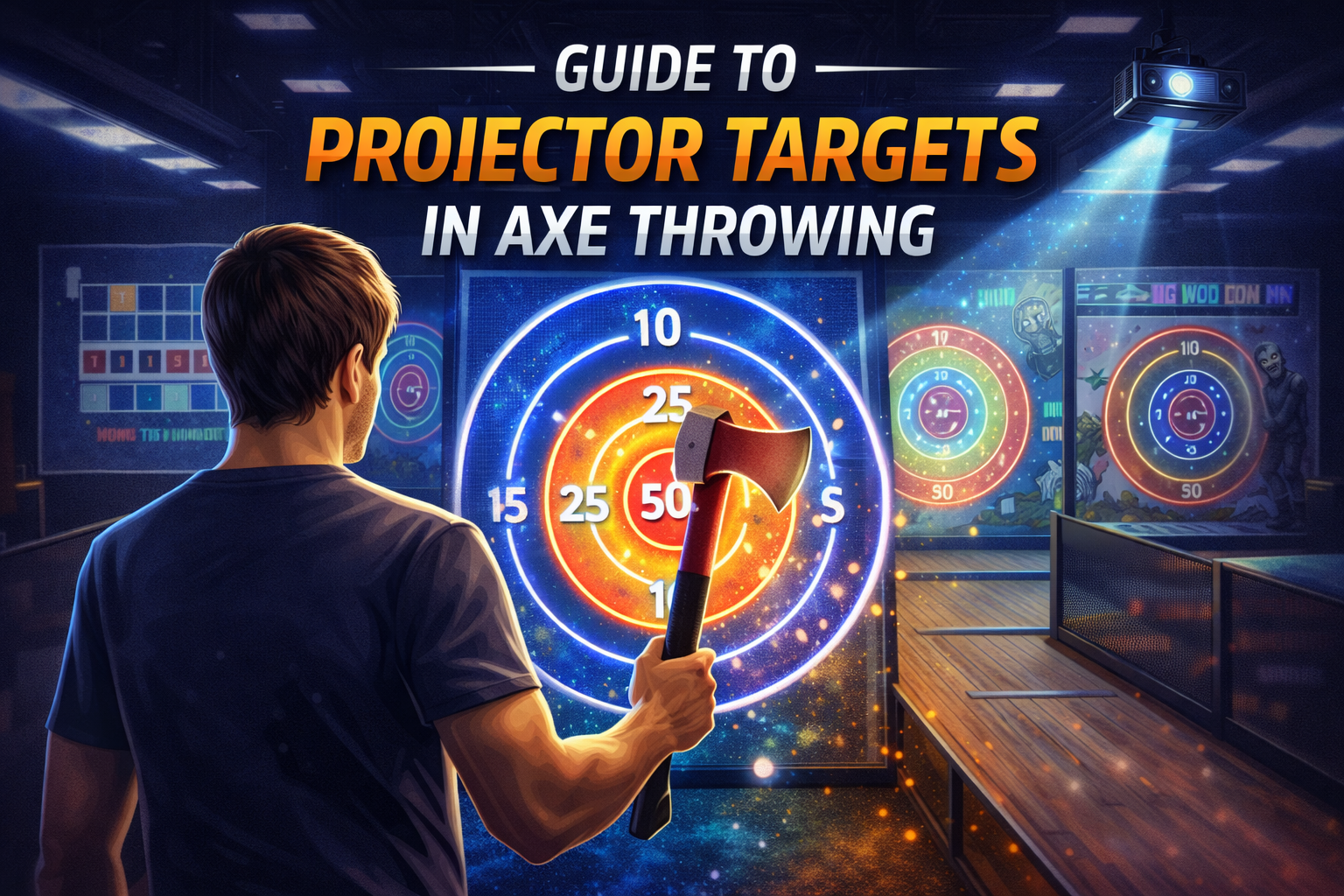
Projector Target Axe Throwing: How Interactive Games Help First-Timers Improve Faster
A science-backed, coach-approved guide for leveling up your throw at Axe Force Austin
Axe throwing has a simple promise: step up, take aim, let it fly. But anyone who's tried it knows the real magic is in the adjustments—a tiny change in grip pressure, wrist angle, or release timing can turn a flat "thunk" into a clean stick right on the bullseye. The question is: how do you improve quickly without it feeling like a repetitive drill session?
That's where projector target axe throwing shines. Instead of throwing at the same static target all night, you're playing interactive games that respond instantly to every throw. You still build the core mechanics, but the practice feels like a challenge—and your brain stays engaged.
In this guide, we'll break down why interactive target games help beginners progress faster, what skills they train, and how to use game modes to go from "first stick" to consistent accuracy—whether you're coming in for a date night, a birthday, or a corporate team event.
What is projector target axe throwing?
Projector target axe throwing uses a digital projection system to display dynamic targets and mini-games on the throwing surface. You still throw real axes in a real lane, but the "target" can change round-to-round: bullseyes, moving targets, countdown challenges, points-based games, and head-to-head modes.
Think of it like the difference between bowling one frame forever versus playing a set of fun, structured games that keep score and push you to try new approaches. The lane stays safe and controlled—only the challenge evolves.
Why interactive games help you improve faster (the science in plain English)
Skill improvement is mostly feedback. When you throw, your brain compares what you intended to do with what actually happened, then updates the next attempt. The faster and clearer that feedback loop is, the faster you learn.
Motor learning researchers often describe skill acquisition in stages—starting with conscious, step-by-step thinking and gradually moving toward smooth, automatic execution. The "three-stage" model commonly attributed to Fitts and Posner is frequently summarized as cognitive → associative → autonomous learning.
Accessible references:
- Motor learning stages overview (Human Kinetics excerpt)
- Motor learning strategies & stages (NIH/PMC open article)
- Stages of learning (Sport Science Insider)
Projector games support this learning process because they deliver frequent, meaningful feedback: score changes, hit confirmation, time pressure, and objective results. Instead of "I think I threw better that time," you get "that adjustment moved me from 12 points to 18 points." That's a clean signal your brain can use.
Gamification keeps attention locked in
Gamification is a fancy word for "turning practice into a game." In learning research, game-like systems often improve motivation and sustained attention—two ingredients that matter a lot when you're doing repeated attempts. If you stay focused longer, you get more quality reps.
A couple of research examples that discuss gamified training and performance outcomes:
Variable targets train adaptability (and that transfers to consistency)
Static targets can encourage one "default throw." Interactive games can change distance markers, scoring zones, or aim points, which nudges you to practice tiny variations. That variability teaches your body to self-correct—so when you miss, you don't spiral, you adjust.
What skills projector games train (without feeling like drills)
- Release timing: Games with quick scoring make you notice the exact moment your axe leaves your hand. Small timing changes produce big stick-rate improvements.
- Aim discipline: Targets with smaller scoring zones teach you to slow down and pick a precise point—huge for beginners who 'spray and pray'.
- Consistency under pressure: Timed modes and head-to-head rounds mimic the mild pressure you feel in friendly competitions or group events.
- Reset routines: When a round starts over, you practice breathing, stepping in, and repeating the same setup—your personal "pre-throw checklist."
- Decision-making: Some modes reward strategy (safe points vs. risky multipliers). Strategy forces you to stay intentional instead of autopilot throwing.
Beginner-friendly technique: a simple checklist that works
If you're new, don't overcomplicate it. Start with a consistent routine, then change only one thing at a time. Here's a coach-style checklist:
- Feet set and balanced (no leaning).
- Grip firm but not crushing (think: handshake pressure).
- Eyes on a single point—not the whole target.
- Smooth backswing and a straight path forward.
- Release with a relaxed hand (don't "push" the axe).
- Follow-through: let your arm finish naturally.
Then use the games as feedback. If you're consistently hitting low, adjust your release timing slightly earlier. If you're drifting left, check your stance alignment and whether you're swinging across your body.
How to pick the best game modes for your group
If you want the fastest improvement
Choose modes with clear scoring and repeatable targets. The goal is lots of attempts with quick feedback. Try: classic bullseye scoring, accuracy challenges, or modes that reward consistent middle hits rather than occasional lucky bullseyes.
If your group is here for fun first (birthdays, dates, casual hangouts)
Pick variety and spectacle: moving targets, time trials, and "party" modes. You'll still improve, but the win condition is laughter and momentum. These modes keep mixed-skill groups engaged.
If you're doing a corporate team event
Go for team formats where everyone contributes: round-robin scoring, relay-style games, or team point totals. It reduces performance anxiety for beginners and makes the event feel collaborative.
Safety still comes first (even when the target is digital)
Interactive targets don't change the fundamentals: one thrower at a time, clear lane boundaries, and a controlled retrieval process. If you've never thrown before, you'll typically get a quick safety briefing and form check so your first throws are safe and successful.
General safety/rules references from established organizations:
- WATL (WATL) rules
- WATL 2024 gameplay rules (includes safety-oriented lane recommendations)
- International Axe Throwing Federation code of conduct
Important note: venues may have house rules that go beyond competition rules. Always follow your coach and posted venue guidance.
A 45-minute "level up" plan you can use on your next visit
Use this simple structure to get better fast without feeling like you're training:
0–10 minutes: Calibration
Find a comfortable grip and release by throwing at a basic bullseye target. Don't chase points; chase clean sticks.
10–25 minutes: Feedback reps
Play a repeatable scoring mode. Change only one variable at a time (stance OR grip OR release timing).
25–35 minutes: Pressure round
Switch to a timed or head-to-head mode. Notice what breaks when you speed up, then slow down and fix it.
35–45 minutes: Fun finale
Pick a wild party mode. End on a high note while your brain is still "learning" the improved throw.
FAQ
Is projector target axe throwing easier for beginners?
It can feel easier because the feedback is clearer and the sessions are structured like games. You still learn the same fundamentals, but it's more engaging.
Will playing games make my form worse?
Not if you start with a quick technique check and keep a consistent routine. Treat the game as feedback—not a reason to rush every throw.
How many throws does it take to get consistent?
Most first-timers start sticking reliably within a short session when they get coaching and repeat good reps. Consistency improves rapidly over a few visits.
What should I wear?
Closed-toe shoes are a smart default. Wear something comfortable that lets you move your shoulders freely.
Ready to try it in Austin?
If you want the satisfaction of real axe throwing with the energy of interactive games, projector target lanes are an awesome way to start. Bring a few friends, pick a mix of skill and party modes, and you'll be surprised how quickly the throws start to click.
Axe Force Austin | South Austin, Texas